

COURSES ▶ When Trust Is Treatment
When Trust is Treatment
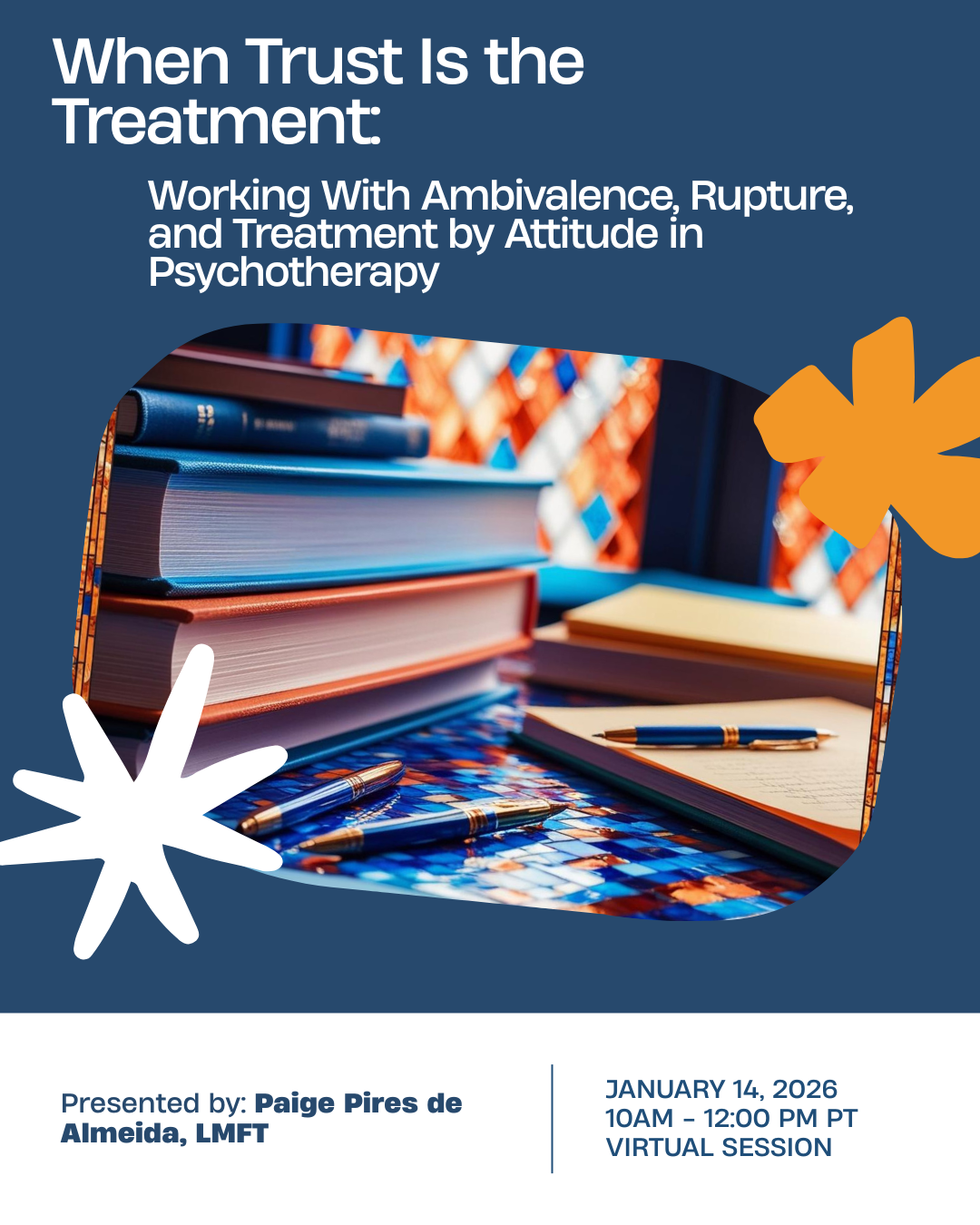
When Trust Is the Treatment, explores the clinical impasses that arise when patients abruptly disengage, criticize the therapy, or struggle to remain in treatment. Drawing on Control-Mastery Theory, this workshop examines how ambivalence toward trust—common in patients with attachment wounds—is not resistance, but a meaningful enactment of deeply held beliefs shaped by earlier relationships. Participants will learn how the therapist’s consistent, empathic attitude becomes a central vehicle for disconfirming pathogenic beliefs and restoring the therapeutic process.
For patients with attachment wounds, the construct of psychotherapy presents an inherent tension. On the one hand, the process depends on the patient’s capacity to establish at least a minimal degree of trust in the therapist. This trust is not absolute, nor is it necessarily present at the outset; rather, it represents a working hypothesis — that engaging with the therapist may not be harmful and might even be helpful. Without such a foundation, patients are unlikely to seek treatment or remain in it long enough for meaningful work to occur.
Virtual Conference
Friday, January 14, 2026
10:00 AM - 12:00 PM PST
Course Description
The purpose of this course is to provide participants with perspectives on personalizing psychotherapy. This workshop focuses on what therapists can do to optimize therapeutic effectiveness as well as to recognize and respond to a patient's unique problems and needs. We have invited experts from different theoretical approaches to describe their theories and approaches, including from SFPRG’s own fifty year history of empirical research and clinical practice.
Instructors: Nancy McWilliams, PhD; George Silberschatz, PhD; Trevor Ahrendt, PsyD; Francesco Gazzillo, PhD; Kevin McCarthy, PhD; David Kealy, PhD; James McCollum, PhD; John Curtis, PhD; Pamela Lyss-Lerman, MD; Paige Pires de Almeida, MFT.
This course will cover:
Why the patient’s perspective is critical to achieving the best outcomes in psychotherapy
How to Identify clinical strategies to personalize therapy to a particular patient
How case formulation can be used to understand the patient’s problems and optimize treatment for their needs

Continuing Education
Course Level: Introductory, Intermediate and Advanced
CE Credits: 15 APA approved CE hours. If you would like CEU's you should indicate so during registration. COA's will be sent within 30 days of the class. You must arrive on time to the course and stay for the entirety of the program to receive CE credit.
CME Credits: SFPRG designates this for a maximum of 15 AMA PRA Category 1 Credit(s)™. Physicians should claim only the credit commensurate with the extent of their participation in the activity.
SFPRG is accredited by the California Medical Association (CMA) to provide continuing medical education for physicians
registrations
Registration Opens: Monday January 6, 2025
Registration Closes: Thursday March 5, at 6pm
Course Schedule: If you would like know more about the schedule for this event please contact our front office at cmt@sfprg.org or 415-561-6771
Cancellation Policy: No refunds are provided for this event. If you have questions about your registration, please contact our office at cmt@sfprg.org 415-561-6771
Co-sponsorship: There is no co-sponsor of this event.
Commercial Support: There is no known commercial support for this program.
Please note that registrations for all PPI classes are handled by the website of our parent member organization SFPRG. You will be redirected to that website to complete your registration. You need not be a member to register, however, if you are a member or have registered for one of our classes before, you will be prompted to enter your information.